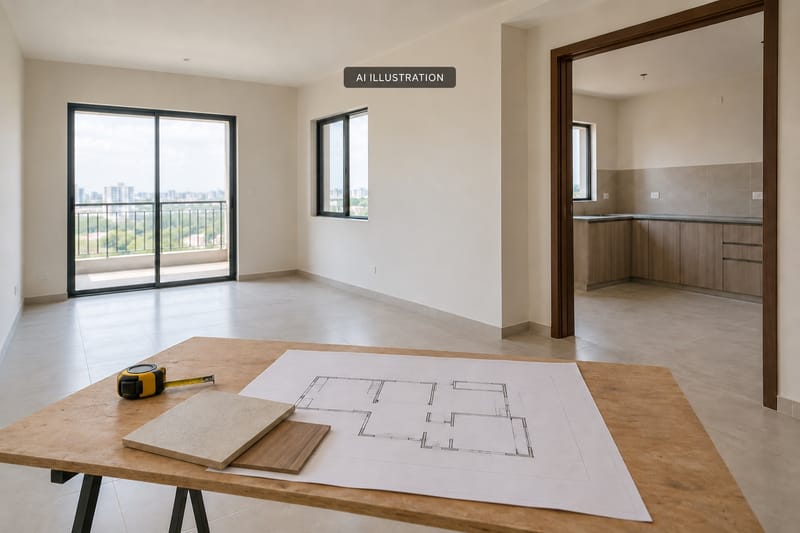
An amenity can be worth much more than the cost of using an equivalent facility elsewhere. A place to exercise, meet neighbours, read quietly or spend time outdoors may make a home more enjoyable and a routine easier to sustain. The emotional and social value is part of the decision.
The mistake is not wanting these things. It is treating the presence of an amenity in a presentation as if its everyday value has already been established.
To compare well, follow each attractive feature all the way from the brochure to the moment you would use it. The aim is to understand what it makes possible, not to dismiss aspiration as frivolous or turn every pleasure into a savings calculation.
Give each attractive feature a real routine
Choose the amenities that genuinely matter to you. For each one, describe the activity in an ordinary sentence: who would use it, at what time, with whom, and what they would do there.
“A gym” is an inventory item. “A place I can reach and use before leaving for work” is a routine. A social space may matter because it makes it easy to see people without organizing another trip. A garden may matter because it offers a pleasant pause between work and home, even if nobody calls it a workout.
Do not manufacture frequent use to justify a preference. Something used occasionally can still matter a great deal. Equally, an impressive facility that does not fit your interests or available hours need not become a priority merely because it looks expensive.
This exercise should help you recognize value, rather than impose someone else’s idea of a sensible lifestyle.
Trace the route from your actual tower
A facility can be within the development and still require more effort to use than the brochure suggests. Begin at the unit or tower you are considering, not the sales office.
Ask about the lift journey, the walking route, road crossings within the site, weather exposure, entrances and any changes in level. Consider the person who will use it. A route that feels straightforward to one resident may be unsuitable for another’s access needs. Check the physical arrangement rather than assuming an accessibility outcome from a rendering.
Where access is permitted and the facility is operating, try the approach at the relevant time. If it is not available to inspect, keep that as an unresolved condition. A picture is not a substitute for the route.
The same principle applies outside the gate. A nearby public park, sports venue or social space may form part of your options, but its route, operating arrangements and suitability need their own checks.
Separate the promise, the delivery and the use
Keep different kinds of evidence separate:
- A brochure or rendering shows how something is being presented.
- A written project or contractual document records a commitment whose exact scope needs checking.
- A completed physical facility shows that something has been built.
- An operating facility with usable access shows what a resident can do today.
These are related, but they are not interchangeable. A finished room may not yet be open. An open facility in one phase may not answer the access question for a home in another. A future facility may be attractive while still depending on delivery and operating conditions.
For a Karnataka purchase, identify the exact project, promoter, registered phase and registration reference before comparing material with the official Karnataka RERA project information. We have not verified any individual project record for this article.
The RERA Act, including sections 11 and 19, addresses project information and agreed amenity and service schedules. Use that as a reason to ask for the relevant written material. It is not a finding that a particular promise has been met or that a particular buyer has a legal remedy.
Understand the operating arrangement
Ask how residents actually gain access. Is it included in the stated charges, separately charged, managed by a different operator, or subject to bookings? What are the hours, guest arrangements, age restrictions, capacity rules and closures? Which answers are current operating rules and which are proposals?
For a facility you would use regularly, find out what happens at the hour you care about. An attractive equipment list does not tell you whether an activity is practical at that time. Avoid inferring demand or crowding from a quiet sales visit.
Also ask who maintains the space, what costs are presently quoted, and what remains to be agreed. A low initial estimate is not evidence that every future operating cost is fixed. Keep documented amounts and unknowns separate, without inventing a standard maintenance rate.
Compare against the alternatives you would actually use
The alternative is not always buying the same amenity independently. You might already have a valued club, a regular class, a public space or friends nearby. A development’s facility may complement that routine, replace part of it, or add little.
Conversely, easy access at home may make an activity possible when an off-site alternative is hard to fit into the week. That is worth investigating without promising that moving will automatically change your habits.
Consider whether several features work together. A usable route, a comfortable shared space and the right operating hours can support a routine better than a longer amenity list with awkward access. The combination is often more informative than the count.
Make an amenity note you can compare
For each feature that influences your shortlist, write down:
- The activity and the value you hope it will add to your life.
- The actual unit or tower, route and time at which you would use it.
- What is presented, what is documented, what is complete and what is operating.
- The access rules, charges, upkeep arrangements and unanswered questions.
- The alternative you would use if this facility were delayed, closed or unsuitable.
Then ask whether you would still like the home if the uncertain parts took longer or worked differently than expected. That does not mean ignoring a future benefit. It means giving today’s usable value and tomorrow’s conditional value the right place in the decision.
A home can support ambition, enjoyment and connection. The strongest amenity case is one you can explain through your life, with the evidence and conditions alongside it.
Continue with the whole-week home comparison and the actual-home and move-in check.
Sources and scope
Public sources checked on 26 October 2026. This is an original buyer-question framework, not a review of a named development, an inspection, a usage survey or an assessment of contractual rights. Confirm project-specific documents and unresolved legal questions with an appropriately qualified adviser.