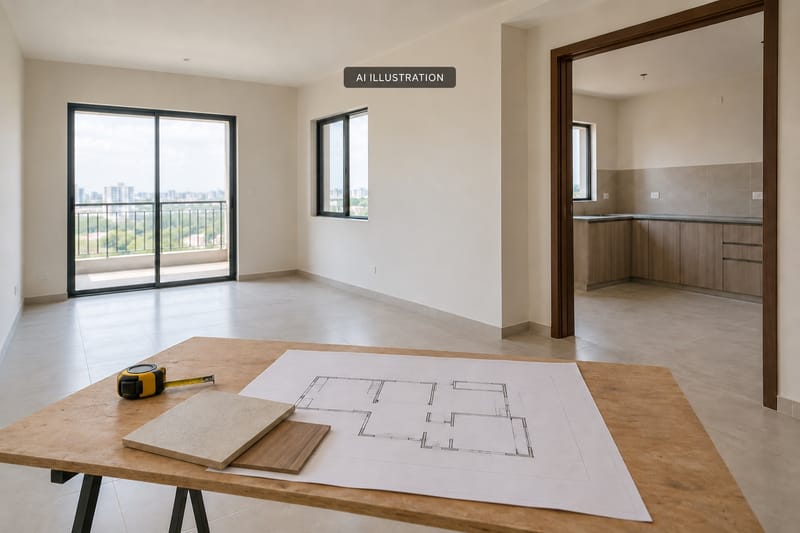
A good home makes more of your life possible. It gives you usable space, brings the people and places you value within reach, and leaves room for the things you enjoy. Its value is not exhausted by the apartment’s dimensions or the rate on a price sheet.
That does not mean price stops mattering. It means the useful question is larger: what combination of home, location, cost and daily routine works well together for you?
It is easy to frame a property search as a sequence of sacrifices: more space or a shorter commute, family nearby or better amenities, a prestigious address or financial comfort. Sometimes there is a real constraint. But before deciding what to give up, look for combinations that improve several priorities at once. A different unit, a different gate, a less conspicuous location or a more flexible layout can change the comparison.
Here is a whole-week method for doing that. It is a decision framework we propose at 7home, not a measured ranking of Bengaluru neighbourhoods.
Start with the week you want to live
Write down the recurring parts of an ordinary week before opening another brochure. Include work, school or childcare, family visits, groceries, healthcare access, exercise, hobbies and time spent at home. Include the parts you would like to make easier, rather than only the routine you have learned to tolerate.
For each activity, note who needs it, when it happens and what makes it work. “Close to family” may mean being able to meet after work, not merely sharing a broad part of the city. “Good for exercise” may mean a pleasant route or a usable facility at the hour you are free. “Space to work from home” may mean a room with a door and a sensible place for a desk, rather than another label on a floor plan.
Keep occasional but important needs on the page too. A routine that works only on an unusually quiet day is a fragile basis for a long-term decision.
Compare journeys from gate to destination
A nearby landmark is a starting point, not the whole journey. Look at the exit you would actually use, the crossing outside it, waiting time, an interchange if relevant, and the last stretch to your destination. Try the journey at the hours that matter to you and keep the date and conditions with your notes.
The National Transit Oriented Development Policy connects useful transit with walkable access, mixed uses and everyday needs. That is a helpful lens for a home search: access is an experience between places, not just a line on a map.
In Bengaluru, check the operator’s current information, including BMRCL’s timings page, and confirm the service you intend to use. Proposed, approved, under-construction, trial-running and operational infrastructure belong in different columns. This article makes no claim about a particular line opening, timetable or door-to-door travel time.
For schools and hospitals, the useful check is equally specific. Confirm admission or service availability with the relevant institution and examine the actual approach to it. A pin on a map cannot answer those questions.
Look for combinations before making concessions
Now compare shortlisted homes against that week. Ask which option makes several things easier at the same time.
A useful balcony and a living area that accommodates your real furniture may matter more than a nominally efficient plan that feels restrictive. A shared facility can support a hobby without requiring another regular journey. A location with ordinary services within practical reach can reduce the effort of errands. These are possibilities to investigate, not benefits to assume from a sales description.
Also look at flexibility. Could the spare room serve a different purpose later? Does the home still work if office attendance changes? Is there a workable alternative when the usual route or facility is unavailable? You do not need to predict your future exactly to avoid an option that depends on everything staying the same.
The objective is not to maximize every preference. It is to find a combination whose strengths reinforce one another, within boundaries you can live with.
Keep hard boundaries outside the score
A weighted score can help a household discuss preferences. It can also hide a serious failure behind attractive extras.
Set your boundaries first: a budget you have assessed, necessary access or safety needs, essential usable space, and the due diligence required for the specific purchase. An attractive clubhouse cannot cancel a failed boundary. Nor should a strong total score turn an unanswered document question into an acceptable answer.
For the remaining preferences, record both your judgement and its evidence. “Feels convenient” is different from a journey you have tried. “Expected to be ready” is different from something you can use now. Leave uncertain items visibly uncertain instead of giving them an optimistic score.
Compare a cost picture that matches the life picture
Put the itemised purchase proposal alongside fit-out work, recurring charges, travel and the other costs needed to make the home usable for you. Separate quoted amounts from estimates and unresolved items. Do not treat a headline rate as a complete budget.
If borrowing, ask the lender for its Key Facts Statement and repayment schedule. The RBI’s April 2024 KFS circular explains APR as a credit-cost measure that includes more than the headline interest rate. APR is not the total cost of owning or living in a home; it belongs inside the wider comparison.
Avoid assigning a cash value to every pleasure or relationship merely to make the worksheet look precise. Time with family, a hobby you can sustain and a home you feel proud of can have real value without a universal price tag.
Finish with a better question for each option
Before your next conversation with a seller, complete these sentences for every shortlisted home:
- This home would make these parts of our week better, and this is the evidence.
- These conditions must hold for that value to be real.
- These costs, routes, documents or access arrangements remain unresolved.
- This is the next check most likely to change our view.
That is a more useful endpoint than declaring a winner from a brochure. You are comparing a life you could realistically live, with room for aspiration and a clear view of its conditions.
For the next layer, use the amenity-to-routine check and the actual-home comparison.
Sources and scope
Public sources checked on 26 October 2026. The TOD policy provides planning context; the weekly-life method above is our proposed buyer tool. No neighbourhood ranking, site inspection, timed journey, school place, medical service or individual purchase has been verified for this article.